 SOUTH AFRICA
What does a Bonus Buy actually cost?
Use the multiplier shown by your game. This is arithmetic in rand, not a prediction or a currency exchange.
The price is a multiple of the base stake
The base stake is the reference amount used by the game’s rules. A purchase multiplier turns that reference into a much larger immediate debit. A 100× buy at a R1 base stake costs R100. At R2 it costs R200. At R5 it costs R500. The stake can look small while the confirmation is asking for a substantial portion of a session budget.
The calculator uses your own hypothetical rand amounts. It multiplies the selected stake by the displayed purchase multiplier, then compares that cost with the budget and an optional hypothetical feature return. It does not ask for an operator account and it does not simulate random results. If your game shows a different purchase multiplier, do not force it into one of these example options.
| Hypothetical base stake | 100× purchase | 500× purchase |
|---|---|---|
| R0.20 | R20 | R100 |
| R1 | R100 | R500 |
| R2 | R200 | R1,000 |
| R5 | R500 | R2,500 |
These are arithmetic examples, not advertised minimum stakes. An operator or particular mode can use a different available stake range. The captured provider demos show USD, so the dollar prices on their buttons must not be read as rand prices.
Natural bonus entry, Bonus Buy and Super Free Spins
Natural entry means the required scatters arrive during an ordinary paid round. You paid the ordinary stake for that round; you did not also press a feature-purchase button. The resulting free spins belong to that paid round’s outcome, along with any other settled return included by the client.
A standard feature purchase instead charges a quoted multiple of the base stake to enter the feature directly. In our inspected 1000 client, that quote is 100×. A Super Free Spins purchase quotes 500× and starts all 49 grid positions with 2× multipliers. The larger price buys a different starting setup, rather than a guarantee that the final feature return exceeds the cost.
The language can be confusing because “super bonus” is often used casually for the 500× purchase. Check the actual button and rules, then price the full debit. Super Free Spins belongs to the current title; Sugar Rush Super Scatter is a separate title; an operator’s free-spins promotion is a third thing. The names do not give those three choices the same terms.
At a hypothetical R2 base stake, compare R200 and R1,000 with your entire session budget before confirming. A purchase quote can change when you adjust the base stake. Returning to a familiar-looking button after a stake change does not mean its monetary price stayed the same.
The two purchase options in Sugar Rush 1000
In the captured 1000 interface, the top-left purchase is ordinary Free Spins and the second is Super Free Spins. The displayed prices at the same base stake differ by a factor of five. Read each confirmation because the feature setup is not the same merely because both purchases contain free spins.
The standard feature retains the game’s marked spots and multipliers through its spins. The Super option has a different setup described in its own rules; do not treat it as a promise that paying five times as much returns five times as much. Our captured initialization gives 96.52% for the first purchase configuration and 96.44% for the second, compared with 96.53% for ordinary play.
A higher entry cost and a different theoretical return are separate facts. Even a configuration with a slightly higher theoretical return can produce a very poor individual purchase. The RTP explanation compares theoretical exposure instead of pretending to know the outcome of one feature.
Bonus chance, odds and frequency: what is actually known?
We do not have a substantiated numeric natural-trigger frequency for Sugar Rush 1000 from the sources inspected for this guide. The rule “three or more scatters trigger free spins” tells you which outcome qualifies. It does not tell you the probability of that outcome on one ordinary spin. Neither a 100× purchase price nor a 96.53% theoretical RTP supplies that missing probability.
Do not turn a buy price into an average wait. A feature costing 100 times the base stake is not evidence that it naturally lands once in every 100 spins. The purchase and ordinary mode have their own configurations. A natural trigger can also occur in a paid round with other returns, so simplistic price-to-frequency division ignores what is actually being priced.
A measured frequency would need a fixed title and mode, a count of completed paid ordinary rounds and the number of those rounds that triggered the feature. Suppose a clearly hypothetical record contained three triggers in 500 completed ordinary rounds: its observed rate would be 3 ÷ 500 = 0.6%. That is an illustration of the calculation, not a Sugar Rush test result, published game probability or schedule for the next 500 rounds.
Keep retriggers separate from initial entry when defining that count. One ordinary round that enters a feature and retriggers twice is still one initial trigger in the ordinary-round denominator. Counting every extra-spin event as a separate ordinary trigger inflates the claimed frequency. Likewise, bought features and incomplete attempts do not belong in that ordinary-spin rate without an explicit separate definition.
Super Scatter’s Ante Bet rules describe a tenfold feature-trigger chance at five times the ordinary base-bet debit in the inspected menu. That is a relative mode claim, not the missing absolute probability, and it applies to that Super Scatter mode. It must not be reused as a Sugar Rush 1000 bonus rate or a guarantee that a feature arrives within ten spins.
Buy Feature and Special Bets in Super Scatter
Super Scatter groups its purchase choices in a Buy Feature menu and puts three additional choices under Special Bets. The game’s current quote is the number to check before confirming. A mode may use the base stake to express awards while charging an enhanced amount to enter the spin; the two amounts should not be confused.
The captured client reports separate mathematical settings for ordinary play, its purchase configurations and three enhanced configurations. That is why a single RTP badge cannot explain every choice. Read the mode description, effective debit and maximum on the actual rules panel before you apply a headline figure.
To compare features, keep a short note of four things: the exact title, the selected mode, the amount debited and the complete return when that round settles. You can record a zero return as a real zero; a disconnected or unfinished feature is an unknown, not an assumed loss or win. We have not supplied invented feature-frequency statistics to fill that gap.
Super Scatter Special Bets: three different paid choices
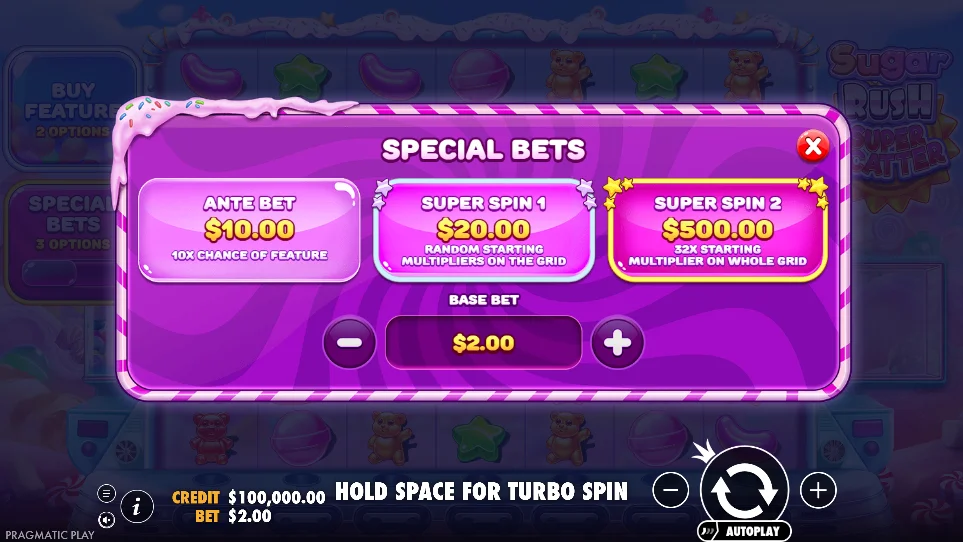
| Mode | What changes at the start | Quoted cost at $2 base bet |
|---|---|---|
| Ante Bet | The rules state a 10× feature-trigger chance; additional scatter presence, with feature purchase disabled. | $10 — 5× the base bet |
| Super Spin 1 | Random positions start with random multipliers from 2× up to 128×. | $20 — 10× the base bet |
| Super Spin 2 | All 49 positions start with a 32× multiplier. | $500 — 250× the base bet |
These are enhanced paid spins, not the separate 100× and 500× free-spins purchases. The menu makes the difference concrete: with the same displayed $2 base bet, the three special choices quote $10, $20 and $500. In hypothetical rand arithmetic at an R2 base bet, those ratios would be R10, R20 and R500. The captured dollar credits do not become rand.
The 10× chance statement comes from this mode’s rules, not from a measured sample on this guide. It does not mean a guaranteed bonus within ten spins, a tenfold RTP or tenfold profit. Super Spin 2’s all-grid multiplier setup also costs far more than an ordinary spin; compare the full debit, not only the base bet printed underneath the menu.
Why does the help say 5,000× but the menu costs 250×?
The Special Bets help uses “bet multiplier” for a different reference unit from the ordinary full spin debit. On that same page, normal play is listed as 20×. To compare a selected mode with the normal full bet, divide its help multiplier by 20: Ante Bet is 100 ÷ 20 = 5 times; Super Spin 1 is 200 ÷ 20 = 10 times; Super Spin 2 is 5,000 ÷ 20 = 250 times.
| Help-panel label | Relative to normal 20× | Actual menu quote at $2 ordinary base bet |
|---|---|---|
| Normal play: 20× | 1× | $2 |
| Ante Bet: 100× | 5× | $10 |
| Super Spin 1: 200× | 10× | $20 |
| Super Spin 2: 5,000× | 250× | $500 |
This reconciles two genuine screens in the inspected client. It does not make Super Spin 2 cost 5,000 times the full $2 ordinary bet. Use the actual monetary confirmation as the final price check in your own client. Our ratios are supported by the captured $2 menu and rendered help, rather than a claim that we tested every possible stake.
What the 500× Super Free Spins purchase changes
The loaded official rules for both inspected clients describe the 500× Super Free Spins setup: every grid position starts with a 2× multiplier. On a 7×7 grid that means all 49 positions start marked with a modifier, instead of waiting for ordinary feature wins to build the starting coverage.
That is a change to the feature’s starting state, not a minimum return. You can still spend more on entry than the entire feature returns. A winning cluster also follows the game’s normal multiplier-combination rule; a 2× mark on each position does not mean you multiply the full stake by 2 forty-nine times. Use the actual paying cluster and the values applied to it.
What a qualifying Super Scatter entry pays
| Super Scatters in the qualifying combination | Instant award in base-stake units | Illustrative R2 base stake |
|---|---|---|
| 1, with enough other scatters to trigger | 100× | R200 |
| 2, with enough other scatters to trigger | 500× | R1,000 |
| 3 | 5,000× | R10,000 |
| 4 | 50,000× | R100,000 |
This table describes Super Scatter, not the 1000 edition. The combination must contain at least three scatter symbols in total. For example, one Super Scatter needs at least two other qualifying scatters; merely landing one special symbol somewhere on a non-triggering spin does not establish the 100× award.
The maximum-win rule still applies. A feature reaching the configured cap ends under the game’s rules; a displayed instant award is not permission to promise additional uncapped winnings. The rand column is hypothetical base-stake arithmetic, not a statement about the USD demo’s cash value.
Read the confirmation in four passes
First read the base stake used to express awards. Second read the complete price that will be debited for this action. Third identify the starting mode: ordinary feature, Super Free Spins or a special bet. Finally, check which balance will pay for it and whether any active operator promotion restricts the choice. These are separate fields even when the interface puts them close together.
For example, a hypothetical R2 base stake with a 500× Super Free Spins quote costs R1,000. If the feature later returns 400× the base stake, that is R800 returned and −R200 net. Reading “400×” without the purchase price makes a losing transaction look like an unqualified win. Conversely, a R1,500 settled return would be +R500 after the same R1,000 cost.
If you cancel the confirmation, no purchase should be assumed in your record. If an action is accepted and the connection drops, do not immediately count it as lost or repeat it to repair the display. Use the operator’s own transaction or game history to establish the accepted action and settlement. The connection-loss checklist distinguishes an uncertain screen from a settled result.
A feature win is not automatically a profit
Suppose a hypothetical 100× purchase at a R2 base stake costs R200. A feature returning R150 has produced winning spins, but the purchase net is R150 − R200 = −R50. A R200 return breaks even. A R350 return gives +R150 net. The comparison is against R200, not against the R2 reference stake.
| Illustrative R200 purchase | Returned | Net result |
|---|---|---|
| Feature pays nothing | R0 | −R200 |
| Some winning free spins | R150 | −R50 |
| Cost fully returned | R200 | R0 |
| Return exceeds cost | R350 | +R150 |
If an instant Super Scatter award is followed by further feature wins, use the client’s complete settled round total and avoid adding an already-included award twice. A large number on a running animation may be only one component or may already be cumulative; the round’s own final summary is the place to reconcile it.
What a R300 budget can and cannot buy
At a hypothetical R2 base stake, a R300 starting budget covers 150 ordinary paid spins if you ignore all returns. It covers only one complete R200 purchase before returns. It does not cover a R1,000 purchase. These are exposure comparisons, not forecasts of how long a session will last: returns can change the balance, and animations change elapsed time.
Reusing every return extends turnover. A theoretical loss calculation based on a R300 initial deposit therefore differs from one based on the total stakes recycled through a game. Decide which quantity you are discussing before comparing strategies or RTP. The strategy guide works through that distinction.
Free-spins features versus no-deposit offers
A game feature belongs to the slot rules. A promotion belongs to an operator’s account terms. A search for “Sugar Rush no deposit bonus” does not establish that a current offer exists, applies to this exact game or permits immediate withdrawal. We have not verified such an offer for this guide.
For any current promotion, check the eligible version, stake per promotional spin, expiry, wagering conditions, maximum eligible stake and any conversion or withdrawal cap. A familiar Sugar Rush logo on a banner does not answer those questions. Keep those account terms separate from a 100× in-game purchase quote.
Use the operator offer checklist before joining. The commercial partner route is a way to explore current listings; it is not a certificate that a named bonus or game is available.
Your questions, answered
Does buying a bonus make the game beatable?
A purchase selects a game mode and concentrates exposure. We have no measured evidence of a profitable future rule for these titles.
Can I try the purchase in the demo?
Open the correct official demo and inspect its available controls. The captured clients show purchase options, using virtual credits only.
Why not call the first 100× buy “100 spins”?
A 100× purchase describes price relative to the base stake. It does not describe a bundle of 100 ordinary paid spins.