 SOUTH AFRICA
Find the five controls that matter
Before placing a practice spin, locate the stake, credit, spin button, information panel and purchase control. These are separate jobs. Credit is a balance. Bet is the amount paid for the round. Buy Feature opens a purchase whose cost can be much larger than the ordinary bet.
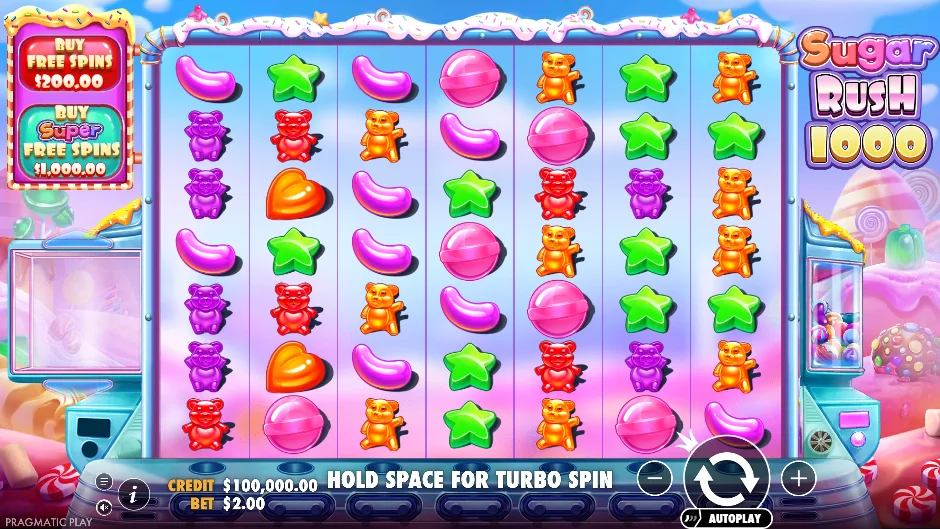
The numbered capture below is Sugar Rush 1000 in the official public demo. In Super Scatter, the left-side feature controls differ, but the distinction between balance, base stake and purchase price still applies. The screenshots show USD virtual credits; the R examples on this page are deliberately labelled arithmetic examples.
 12345
- Grid: seven columns and seven rows. Adjacent matching sweets form paying clusters.
- Bet: the full stake for one paid spin. Credit is the virtual balance, not a prize.
- Spin: begins the paid round. The adjacent − / + controls change the stake.
- Information: opens this version’s paytable and rules.
- Buy feature: a separate, larger debit; read the cost before confirming.
Use the paytable to check a real cluster
Count connected matching sweets
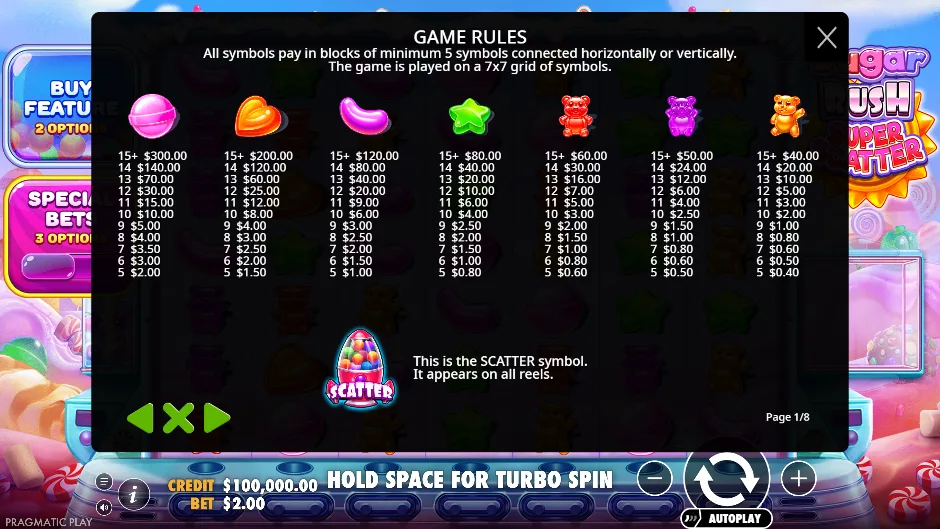
Five identical sweets must connect horizontally or vertically. A corner touch does not join two groups. Read the matching symbol and count in the paytable; do not combine different sweet types to reach five.
Follow positions through the tumble
A winning sweet disappears. Its position can remain marked and later develop a multiplier under the rules. Watch the square, not a sweet that has already disappeared. Use the walkthrough below to follow that sequence one step at a time.
Compare the full return with the full cost
For a hypothetical ordinary R2 round returning R1.60, the result is −R0.40 net. R6 returned would be +R4. If you bought a R200 feature, subtract R200 instead of R2.
Read the feature guide for purchases and the RTP guide for the inspected settings. To inspect the buttons yourself, open the edition-specific demos.
Play one round from beginning to end
First choose the exact title and read its rules. Next set a base stake that you understand, with any special-bet mode either disabled or clearly identified. A normal spin and an enhanced mode can have different effective debits. Use the ordinary spin button when learning the basic mechanism.
When the grid lands, look for groups of identical symbols connected along edges. If a qualifying group pays, those symbols clear and replacements drop in. Another group can pay during the same sequence. You do not need to press spin again for each tumble; the round continues until there are no further qualifying wins or a feature continues it.
When the round settles, read the final return once. Suppose a hypothetical R2 spin pays R0.40, R1.00 and R2.60 across three tumbles. The total returned is R4.00 and the net profit is R2.00. Do not add the displayed running total a second time. If instead the complete round returns R0.40, the net is −R1.60.
| Illustrative R2 round | Gross return | Net after original R2 stake |
|---|---|---|
| No paying cluster | R0.00 | −R2.00 |
| One small cluster, then no further win | R0.40 | −R1.60 |
| Three tumbles: R0.40 + R1.00 + R2.60 | R4.00 | +R2.00 |
What counts as a connected cluster?
The game uses a seven-by-seven grid. At least five identical paying symbols must connect horizontally or vertically. Five pink sweets scattered around the grid are not enough if they do not connect. A diagonal touch at a corner does not connect two groups. This is why the game is described as cluster pays rather than a fixed-payline slot.
Different symbols have different paytable values, and larger clusters have higher awards. The information screen is the right place to verify the value for the selected stake. The captured ordinary values correspond to 0.20× the full stake for five green stars and 0.30× for five red bears. In hypothetical rand arithmetic, a red-bear cluster at R2 therefore starts at R0.60 before qualifying position multipliers.
The exact paytable matters more than a general statement that bears are “high-paying”. Compare the cluster size and the full-spin stake shown by the client. A value shown in the information screen may already be expressed as a money amount at the current stake, rather than as an extra multiplier you should apply a second time.
Follow a cluster through one spin.
A fixed teaching example, not a game or recorded result. Choose “Next step” to see how winning positions become multiplier spots.


Red cluster → marked spots → 2× multiplier → next paid spin resets the base-game spots.
Read a complete round: stake, return and net
For this hypothetical example, set the full ordinary stake to R2. The game deducts R2 when the paid round begins. A first cluster returns R0.40, disappears and leaves marked positions. A second cluster returns R1.20. No further group qualifies, so the tumble sequence ends with R1.60 returned. The net is R1.60 − R2 = −R0.40. Two paying clusters still produced a losing paid round.
| Stage in this teaching example | New stake | Return added | What it means |
|---|---|---|---|
| Start ordinary round | R2 | R0 | One paid round begins. |
| First paying cluster | R0 | R0.40 | A tumble continuation, not another purchase. |
| Second paying cluster | R0 | R1.20 | Add this to the same round’s return. |
| Round settles | R0 | R1.60 total | Net result: −R0.40. |
Now change only the hypothetical final return: if the round returns R6, net profit is +R4. If it returns exactly R2, it breaks even. The same subtraction works for a feature purchase, but its cost is the full buy price. A R200 purchase returning R150 is −R50, regardless of how many free spins or winning animations occurred inside it.
Do not add a running total to its own components. If a screen says TOTAL WIN R1.60 after showing R0.40 and R1.20, the total is already the sum. For a record, keep one settled return for the paid round and optionally retain the component events as explanatory detail. This prevents a tumble, a retrigger and the final summary from being counted as three independent paid wins.
Marked spots and multipliers: follow the position
A winning symbol marks its position when it disappears. A later qualifying win using that same spot can introduce a 2× multiplier. Further qualifying hits on the position can double it again. In 1000 and Super Scatter the ceiling is 1,024× per spot. The first winning cluster does not automatically give every position a 2× multiplier immediately.
If a winning cluster includes multiple multiplier positions, the qualifying multiplier values add for that win under the game’s rules. For a simple arithmetic illustration, a base award of R0.60 with qualifying 2× and 4× positions gives a combined 6× modifier and R3.60 for that award. Check the actual game display before applying the calculation; the animated running total may already include it.
Base-game markings belong to that paid spin’s tumble sequence. A new paid base spin starts fresh. In free spins, the feature retains its marked positions and multiplier spots until the feature ends. This persistence is the practical reason a late feature spin can look very different from its first spin.
How to read symbols and cluster values
Open the information panel in the exact title and find the ordinary-symbol paytable. Pick one symbol, then find the column or row for the cluster size. The award concerns a qualifying connected group, not every occurrence of that symbol anywhere on the grid. Five identical symbols split into disconnected groups do not automatically create a five-symbol cluster.
In the inspected $2 ordinary client, a five-symbol green-star group returns $0.40 and a five-symbol red-bear group returns $0.60 before relevant multiplier modifiers. Relative to the full $2 stake, those are 0.20× and 0.30×. A five-symbol pink-sweet group returns $2 at that setting. The symbols therefore have different pay values even though they share the same five-symbol minimum.
For hypothetical rand arithmetic at the same 0.30× ratio, a R2 reference stake would return R0.60, while a R5 stake would return R1.50. The ratio scales with the stake; this is not a dollar-to-rand exchange rate. Always check the client’s current denomination and full stake before reading a monetary paytable value.
Scatters are handled under the separate feature rules rather than the ordinary connected-sweet calculation. A Super Scatter also has its own conditions. Read the feature-entry award table instead of assigning every special symbol the ordinary five-symbol rule.
Scatters and free spins
Scatters have their own trigger role. They do not need to form an ordinary matching-sweet cluster in order to participate in the feature trigger. The provider describes a trigger at three or more scatters, with the number of starting free spins depending on the qualifying trigger. Additional qualifying scatters can retrigger the feature according to that version’s help.
In Sugar Rush 1000, the game also offers a Super Free Spins purchase. In Sugar Rush Super Scatter, a qualifying Super Scatter at feature entry can award an instant prize, and the client offers additional modes through its Special Bets menu. These are different mechanics, even though both titles contain the word “Super” somewhere in the interface.
Let the feature finish before deciding whether the round made money. If you entered through a purchase, the reference cost is the full purchase. A hypothetical R200 buy returning R150 is a net −R50, even if individual free spins contained wins. The purchase guide shows the same distinction with editable amounts.
How many free spins do the scatters award?
| Qualifying scatter symbols | Initial free spins in the inspected rules |
|---|---|
| 3 | 10 |
| 4 | 12 |
| 5 | 15 |
| 6 | 20 |
| 7 | 30 |
The inspected help uses these counts for a qualifying trigger and for additional spins awarded by a qualifying retrigger. A retrigger extends the current feature; it does not mean you paid for a new ordinary round at that moment. Track the total feature return through to its final settlement rather than resetting your accounting every time the remaining-spin counter increases.
The count alone does not describe the whole feature. Marked positions and multipliers persist during free spins, while Super Free Spins starts the entire grid at 2×. In Super Scatter, an eligible special scatter combination can also add an entry award. Those are different rule components, so “10 free spins” is not a complete description of every way to enter a feature.
A cap can end a round under the maximum-win rule before every remaining feature spin is played. Do not promise that reaching a large award leaves all listed spins available as extra uncapped prizes. The selected mode’s own help and final settlement govern the result.
Sugar Rush, 1000, Super Scatter: name the version
| Feature | Original Sugar Rush | Sugar Rush 1000 | Super Scatter |
|---|---|---|---|
| Game identity | Sugar Rush | Sugar Rush 1000 | Sugar Rush Super Scatter |
| Winning pattern | Connected matching clusters | Connected matching clusters | Connected matching clusters |
| Multiplier ceiling per spot | 128× | 1,024× | 1,024× |
| Distinctive feature | Original multiplier grid | Higher spot-multiplier ceiling | Super Scatter awards on feature entry |
| Demo on this guide | Provider’s original game | Open 1000 demo → | Open Super Scatter demo → |
Choose the title inside the game, not only the name on a catalogue tile. A high-roller edition needs its own stake and rules check; we have not substituted it for the ordinary 1000 demo. For a detailed explanation, use the version comparison.
Phone controls and sound
Open one demo at a time. Use its full-screen control when a narrow portrait window makes the stake hard to read, then check whether landscape helps on your phone. Keep the browser’s address and back controls in mind when leaving full screen; a page refresh may begin a new virtual session.
The game’s information panel remains the source for the current mode. If the sound is inconvenient, use the in-game sound control. If a connection problem interrupts a real-money round, use that operator’s account history and support route rather than assuming a missing animation means a lost or settled stake. See the mobile launch checklist and demo selector.
Your questions, answered
Does Turbo improve the chance of winning?
It changes presentation speed, not a demonstrated edge. A faster sequence can also make it easier to lose track of paid rounds and budget.
Can a cluster pay but the round lose money?
Yes. Compare the full return with the stake. A R0.40 return on a R2 spin is still a net −R1.60.
Do multipliers stay forever?
In the base game, they belong to the current spin’s sequence. The free-spins feature retains them during that feature, then ends under its rules.
Change one thing at a time when reading a cluster
When checking a screenshot, trace the group through horizontal or vertical neighbours. A diagonal contact alone does not connect two sweets. Count each occupied cell once, even when several different routes join the same group.
For a useful practice check, first ignore the multiplier labels and identify the connected ordinary group. Count the matching symbols, check edge connections and find that symbol’s paytable entry. Only then inspect whether its positions qualify for a modifier. This order prevents a large tile number from distracting you from a group that never satisfied the ordinary matching condition.
Now ask what the next event is. Another tumble in the same paid spin can use the developing ordinary-round marks, while a new ordinary paid spin starts fresh. A continuing free-spin feature retains its own positions according to its rules. Those three events can follow each other quickly on a small screen, so a change in the button state or feature counter can be more informative than a familiar candy background.
If the ordinary award, position modifier and final total do not fit the explanation you expected, keep the original image and read the exact edition help again. A diagram can teach a connection rule, but it cannot establish an unseen account settlement. The numbered screenshot, full-size paytable and dedicated demo are the next useful checks before making the same interpretation in a cash account.