 SOUTH AFRICA
Identify the edition from the title, then read its feature
The candy colours alone are a poor identifier. Read the whole title at the right of each original screen. Both versions can show a 1,024× position, so that number does not distinguish them. Then open the information panel to check the feature conditions for that title.
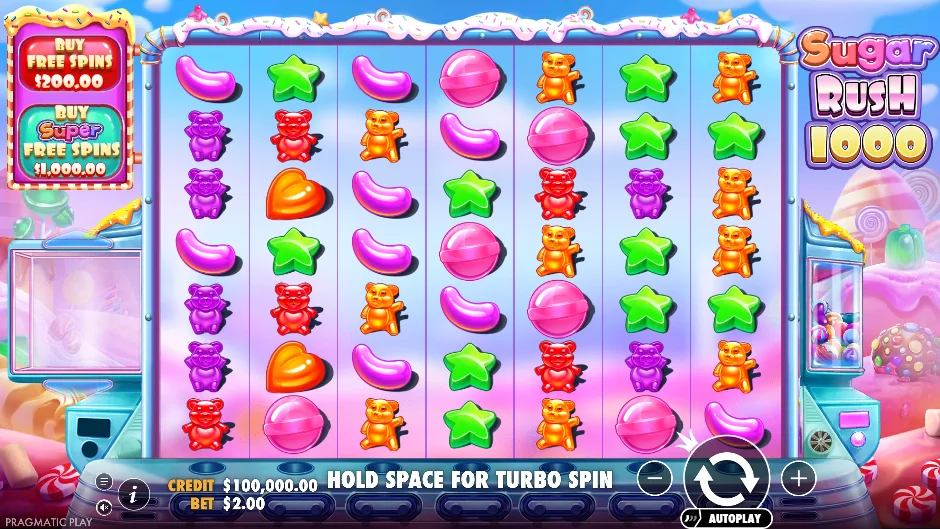
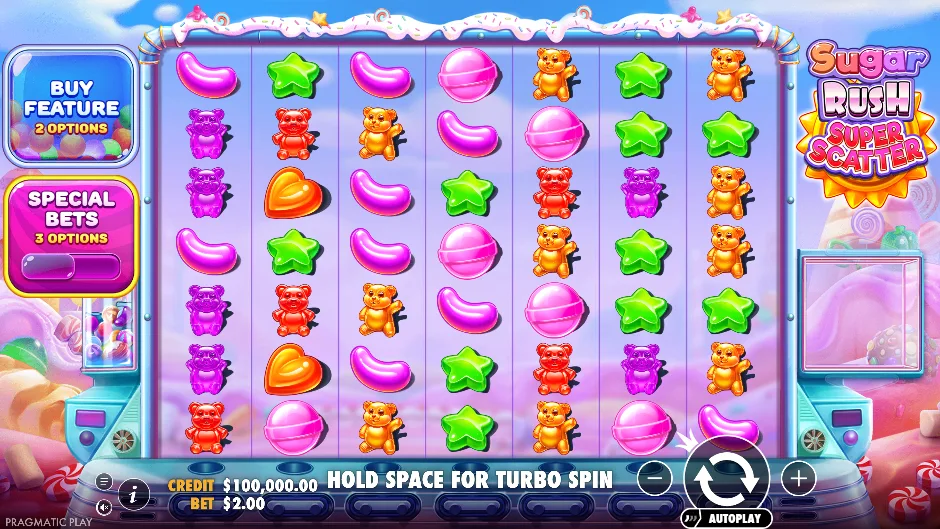
On a small screen, swipe the table sideways to see both editions. You can also focus the table and use the arrow keys.
| Question | Sugar Rush 1000 | Sugar Rush Super Scatter |
|---|---|---|
| What changes the choice? | The position-building free-spins feature | An additional conditional Super Scatter entry award |
| Does a position multiply the balance? | No; it acts under the winning-cluster rule | No; it acts under the winning-cluster rule |
| Standard buy at R2 | R200 (100×) | R200 (100×) |
| Super buy at R2 | R1,000 (500×) | R1,000 (500×) |
| Try the correct version | 1000 demo → | Super Scatter demo → |
These prices alone do not make either title a better return. With an R300 teaching budget, one R200 purchase leaves R100 before any return; neither R1,000 purchase fits. In Super Scatter, the special award also requires the qualifying trigger combination. Compare the complete feature conditions and cost calculator before confirming a buy.
Three numbers that mean different things
1000 is an edition name. 1,024× is the position-multiplier ceiling. 100× can be a feature purchase multiple. At R2, that purchase costs R200; none of these numbers is a promise that the next round will return R200.
| Feature | Original Sugar Rush | Sugar Rush 1000 | Super Scatter |
|---|---|---|---|
| Game identity | Sugar Rush | Sugar Rush 1000 | Sugar Rush Super Scatter |
| Winning pattern | Connected matching clusters | Connected matching clusters | Connected matching clusters |
| Multiplier ceiling per spot | 128× | 1,024× | 1,024× |
| Distinctive feature | Original multiplier grid | Higher spot-multiplier ceiling | Super Scatter awards on feature entry |
| Demo on this guide | Provider’s original game | Open 1000 demo → | Open Super Scatter demo → |
The original Sugar Rush
The original game establishes the family’s basic loop: connected clusters, tumbles, marked positions and a free-spins feature with persistent spots. Its position multipliers stop at 128×. If your game title says only Sugar Rush, use that version’s paytable rather than importing a maximum from a later release.
A tile can look familiar because the family reuses its sweet-shop theme. The title on the actual game screen is a better identifier than the colours of a thumbnail. The provider’s original Sugar Rush page is the reference for this edition; the two embedded clients on our guide are the newer titles.
Sugar Rush 1000: the position-multiplier edition
The 1000 edition raises the multiplier ceiling per position from the original 128× to 1,024×. A paying group still has to use a qualifying marked position for the modifier to matter. A 1,024× ceiling does not mean every spin pays 1,024 times the stake, and it does not describe the number of free spins.
Our captured client offers standard Free Spins and Super Free Spins purchases. At its displayed $2 base stake those buttons show $200 and $1,000: 100× and 500× the base stake. The ordinary and purchase RTP configurations are different. The word “Super” on the larger purchase refers to a mode in 1000, not a hidden switch to the separate Super Scatter release.
Open the 1000 guide for the controls and its own demo for practice. Keep any decision about feature cost tied to the quote in that same game client.
Super Scatter: a different feature-entry symbol
Super Scatter keeps the grid and position-multiplier idea, then adds its named special symbol. When a qualifying feature trigger includes Super Scatters, an instant award can be attached to that entry. The number of these symbols in the qualifying combination matters; a casual glance at an ordinary scatter is not enough to infer that award.
Its interface also has a Buy Feature menu and a separate Special Bets menu. Those controls need their own price and mode check. The regular-mode maximum described for the title is 50,000×, but the captured client contains different settings for enhanced modes. Do not use one large headline maximum to explain every mode.
If this is the version you want, open the Super Scatter guide or its demo. You will see the actual Super Scatter wordmark and menu, rather than a relabelled 1000 client.
Three examples that identify the version correctly
You open a game called Sugar Rush 1000 and see a button for Super Free Spins. That is still the 1000 edition. The button purchases a feature setup inside the current game; it does not install or launch Sugar Rush Super Scatter. Use the 1000 demo and 1000 purchase rules for that screen.
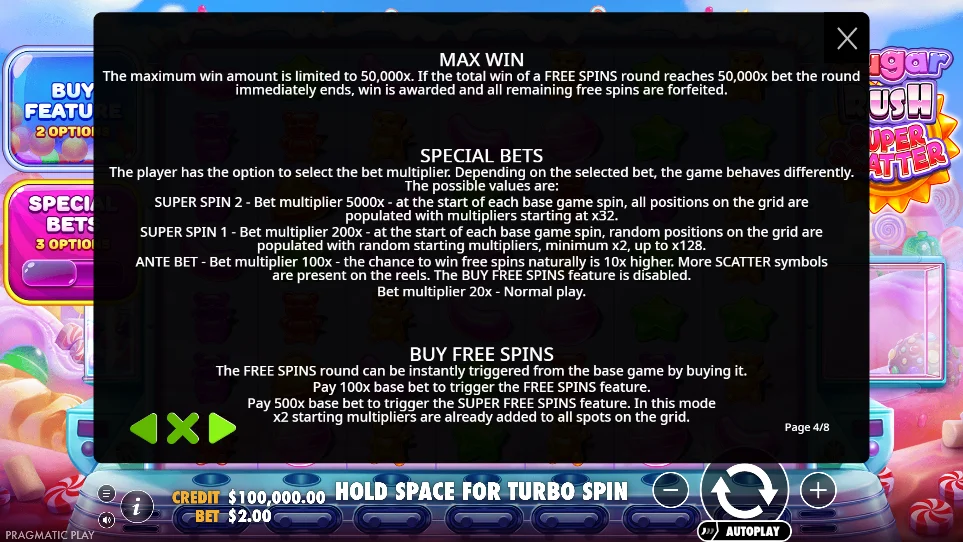
You open Sugar Rush Super Scatter and see Ante Bet, Super Spin 1 and Super Spin 2 under Special Bets. Those are choices within Super Scatter. A Super Spin label is not the name of a third Sugar Rush release, and its full debit may be much larger than the ordinary reference stake. Compare the actual menu prices before using an ordinary-spin budget.
You open a lobby result called Sugar Rush 1000 High Roller. Keep the full subtitle when checking it. This guide has not inspected that client, so the ordinary 1000 screen and minimum-stake examples are not proof of its configuration. If the exact client is inaccessible, the honest identification is that you have a different named listing, rather than a tested copy of the ordinary game.
If all you have is a cropped grid screenshot, ask for the full game title and information panel. The same candy shapes can appear across the family. A large win caption, pink background or familiar bear does not resolve the version. The version finder gives you the correct next route once you can read the title.
What if you searched “Sugar Rush 1000 Super Scatter”?
That phrase combines the names of two releases. The practical question is which feature you are looking for. If you mean 1000’s Super Free Spins buy, use the 1000 demo. If you mean the sun-shaped special scatter and instant feature-entry award, use Super Scatter. There is no need to guess from a candy screenshot.
Our version finder asks for the visible title and takes you to the relevant guide. An unfamiliar provider name or a title such as Sugar Rush Adventure should be checked on its own terms. Similar names can refer to other products, and a guide to this slot family should not imply they share the same rules.
Which Sugar Rush have you opened?
Read the title inside the game, then choose the closest match. Similar sweets do not mean the same rules.
High Roller deserves its own check
A public Hollywoodbets search result names Sugar Rush 1000 High Roller. That is a reason to inspect the full game name, not a reason to assume its minimum stake or client is the ordinary 1000 version. We did not substitute that listing for an authenticated test of the base title.
When an operator offers several nearby names, read the full title, stake menu and information panel after launch. Do the cost calculation using that actual base stake and purchase quote. A small price example from another edition can otherwise be misleading.
Compare choices at the same budget, not the same headline
At a hypothetical R2 base stake, a 100× feature buy is R200 and a 500× buy is R1,000. A R300 budget therefore funds one complete R200 buy before returns, or 150 ordinary R2 spins before returns; it does not fund the R1,000 buy. These are different exposures even though the reference stake remains R2 in each example.
In the captured Super Scatter menu, the same R2 teaching stake would correspond to R10 for Ante Bet, R20 for Super Spin 1 and R500 for Super Spin 2 if the displayed five-, ten- and 250-times ratios were applied in rand. Those are hypothetical mode-price comparisons. The captured player uses dollars, and an operator’s actual currency and options still need checking.
Choose the version for the rules you want to understand, then choose the mode for the cost and setup you intend. A larger position ceiling or maximum prize is not a substitute for either step. The maximum-win guide explains why comparing large multiples without their denominators can mislead.
Your questions, answered
Which version is better?
It depends on which mechanism you want to understand. The table compares mechanics and configurations; a larger maximum or different RTP does not guarantee the better outcome in a short session.
Can I compare them without loading both at once?
Yes. Read the comparison, then open one demo page. Switching games closes the previous embedded frame instead of keeping two clients running.
Compare the memory of a position, not just the candy
The most useful comparison begins with what survives the next event. A winning sweet disappears, while its position can remain marked. Reusing a qualifying marked position can introduce and then increase a multiplier. During an ordinary paid spin, that development belongs to its tumble sequence. During free spins, the feature can retain its marked and multiplier positions across its spins. Those are different scopes of memory, not a permanent improvement stored in an account.
That persistence explains why a late free-spin board can look more developed than its first board. It does not tell you that the next cluster will cover the strongest position. The symbols still have to form a qualifying connected group. A large number in a corner with no relevant winning group is not an automatic award, and the visual richness of a grid is not a prediction of its next return.
When comparing screenshots, ask whether they show an ordinary round, a naturally triggered feature, a purchased feature or a selected Special Bet. A developed feature grid and a fresh ordinary grid can look dramatically different without belonging to different editions. Name the title and the current action before deciding that one screenshot proves a better version. The full rules guide explains how the position changes after each qualifying use.
What the jump from 128× to 1,024× actually adds
The familiar multiplier progression doubles: 2×, 4×, 8×, 16×, 32×, 64× and 128×. The newer ceiling allows the additional levels 256×, 512× and 1,024×. This is why the exact ceiling can be 1,024× even though the edition name uses 1000. It is a limit on a position’s multiplier, not a count of spins or a cash amount paid whenever that title loads.
Reaching a ceiling still requires the qualifying progression described by the rules. The first winning use marks a position rather than instantly granting the top multiplier. Later qualifying uses can develop it, and the feature can finish without producing the sequence someone hoped for. Listing the extra levels therefore explains the rule change; it does not establish how often a new edition reaches them.
It also does not rank the complete round return. The size and value of the cluster using a position matter, as do other qualifying multipliers and the round limit. A small relevant award with a large modifier and a larger award with a smaller modifier can produce different totals. Read the actual cluster and settlement rather than treating the largest visible tile as the whole result.
Check the connection rule before comparing the result
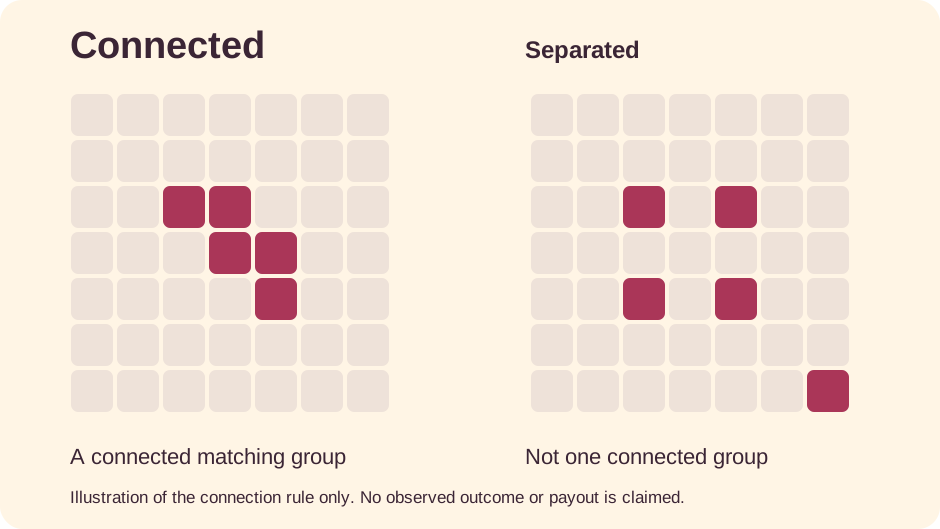
Sugar Rush pays connected matching clusters. The five marked cells on the left below form one connected group through shared edges. The five on the right are separated. The same number and colour do not give those two layouts the same status. This matters when moving between candy-themed games: a pays-anywhere rule from a different family must not be imported into Sugar Rush.
The diagram is a teaching layout on a seven-by-seven grid, not a server outcome or an exact paytable award. Its job is to make the connection test visible. After establishing a qualifying group, the ordinary symbol value and any relevant position modifiers still need to be read. You cannot calculate the cash return from the number of coloured cells alone.
A practical choice between 1000 and Super Scatter
Use the 1000 guide when you want to understand the higher position ceiling and the standard versus Super Free Spins choices inside that title. Use Super Scatter when your question concerns the special feature-entry symbol or its separate Special Bets menu. A Super purchase in 1000 is not a doorway into the Super Scatter release. The name of the option and the name of the game answer different questions.
Super Scatter adds a conditional entry award, not a promise that every later free spin contains a special scatter. It also does not remove the connected-cluster requirement for ordinary sweets. Before interpreting an entry celebration, verify the qualifying scatter combination and whether the displayed final amount is cumulative. The exact edition guide keeps those feature conditions together; this comparison tells you which one to read.
If your question is what an action costs, the purchase guide is the deeper answer. Its ledger compares the actual confirmation price with the whole settled return. We do not repeat the entire calculator here because an edition choice and a spending calculation are different decisions. In either case, a small ordinary reference stake should not disguise a much larger purchase or enhanced-action debit.
The final check happens at the operator you choose. Confirm the exact title, selected mode, currency and current terms. Our public listings and official demo captures are evidence of those sources, not a funded account or withdrawal test. If the requested edition is unavailable, the partner destination may have other suitable games, but that possibility is not a verified listing of every Sugar Rush release.